When is whale watching season
To plan your trip with confidence, it helps to distinguish between the three periods that define the cetaceans’ arrival in the department:
| Period | Months | Detail and official source |
|---|---|---|
| Biological presence | June to November | Natural period when solitary whales and family groups frequent the protected area (Parques Nacionales). |
| Regulated tourist season | July to October | Official window authorized for commercial whale-watching ecotourism navigation (PNN Uramba Bahía Málaga). |
| Peak density | September and October | Months with the highest concentration of mothers with calves and surface activity (breaching and fin slapping). |
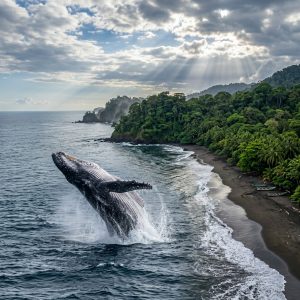
The specific start and end dates of the season are formalized each year by the district administration and environmental authorities. If you’re looking for the best odds of seeing breaches and calf play at the regulated close range, the weeks between late August and early October offer the best watching conditions.
Where to see whales in Valle del Cauca
The undisputed epicenter of whale watching is the Uramba Bahía Málaga National Natural Park, located in the special district of Buenaventura. This calm-water bay, surrounded by dense tropical forest and mangroves, has one of the highest calf birth rates in the southeast Pacific.
Logistics are organized around two key points:
- Buenaventura Tourist Pier: The mandatory mainland departure point, where visitors board coastal boats that cross open water toward the northern shore of the bay.
- Juanchaco, Ladrilleros, and La Barra corridor: Coastal fishing communities where visitors disembark and board smaller, specially authorized community boats to venture into the bay in search of the cetaceans.
The protected area is jointly managed by Parques Nacionales and six Black community councils from the region (Chucheros, La Plata Bahía Málaga, Juanchaco, Ladrilleros, La Barra, and Puerto España). The guides and environmental interpreters on board come directly from these local communities.
Official rules for responsible whale watching
The activity is regulated by a joint circular issued by the Ministry of Environment, the Ministry of Commerce, and the General Maritime Directorate (Dimar), along with Uramba Park’s own regulations. Compliance with these measures is mandatory for crew and passengers alike:
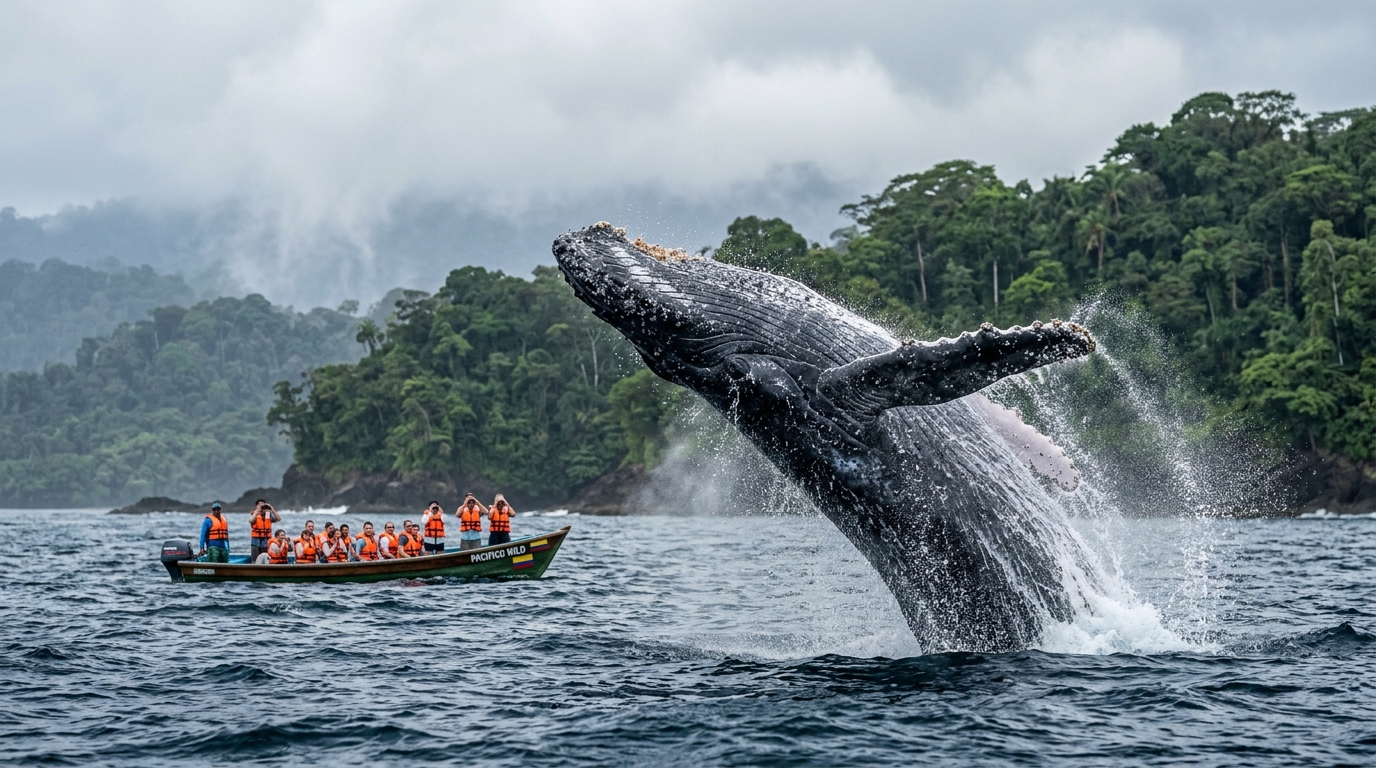
- Minimum safety distance: Boats must stay at least 200 meters from whales. If a mother and calf are spotted, the minimum distance increases to 500 meters, and following their path is strictly prohibited.
- Maximum observation time: Time spent with a group of whales cannot exceed 30 minutes if there’s a single boat present, or 15 minutes if multiple boats are at the same spot.
- Number of boats: National regulations set a maximum of three boats at a time around a group (inside the park itself, up to five smaller boats are authorized, with engines in neutral).
- Approach angle: Boats must always approach at a 45-degree angle from behind the animal, never head-on or cutting across its swimming path.
- Reduced speed: In the observation zone, navigation is limited to a maximum of 5 knots. The engine must stay running at idle so its sound lets whales sense the boat’s position and avoid collisions.
- Strict prohibitions: Using drones without a scientific permit, swimming, diving, or trying to feed or touch the cetaceans is banned.
A responsible operator will never chase a whale or force an improper approach. Respecting time limits and distances protects the cetaceans’ lives and the mothers’ peace during calf-rearing.
How to check whether an operator is legal
Three independent credentials are required to legally operate whale watching in Bahía Málaga, and no tourist should overlook them:
| Credential | Issuing body | How to verify it |
|---|---|---|
| National Tourism Registry (RNT) | Ministry of Commerce | Visible certificate with an active code on the official RNT platform. |
| Departure license and clearance | Dimar (Harbor Master’s Office) | Inspection of safety equipment, life jackets, and boat registration at the pier. |
| Whale-watching authorization in the PNN | Parques Nacionales | Official authorization flag visible on the boat and an environmental interpreter on board. |
Among the legally established operators with active RNT registration are agencies such as Mangle Experiencias Nativas (RNT 112803, an operator endorsed within the PNN), Avistamiento de Ballenas Colombia S.A.S (RNT 215644), Best Pacific Adventures (RNT 49652), and Maraventur (RNT 256099).
Rates, transport, and reference costs
Costs vary depending on whether you book an all-inclusive tour package from Cali or Buenaventura, or make the trip on your own, arranging the boat legs directly at the ticket window:
| Service | Estimated rate | Detail and notes |
|---|---|---|
| Full organized day trip | Approx. $390,000 COP per person | Includes round-trip transport Buenaventura–Juanchaco, a 1-hour whale-watching outing, a scenic tour of Isla Palma, lunch in Juanchaco, and medical insurance. |
| Scheduled boat, Buenaventura to Juanchaco | Approx. $70,000 COP per person / one way | Public sea transport fare on a fast boat (45 to 60 minutes of navigation). |
| Local whale-watching outing from Juanchaco | From $100,000 COP per person | Departure on a smaller, authorized boat into Bahía Málaga with an environmental interpreter (1 to 2 hours). |
| Transfer from Juanchaco to Ladrilleros | Approx. $5,000 COP per person | In a traditional mototaxi cart along the unpaved coastal road (10 to 15 min). |
| Tourist pier fee | Separate local charge | Paid directly at the entrance ticket window at the pier in Buenaventura. |
How to get to the pier and board the boat
To get from Cali to Buenaventura, take the road to the sea (approximately 2.5 to 3 hours by public bus or private vehicle). Once in the Buenaventura district, head to the Tourist Pier in the central area.
Unit 2 of the pier houses the Destino Pacífico office and the authorized sea transport ticket windows. Fast boats to Juanchaco run at regular times in the morning (10:30 a.m.) and midday (1:00 p.m.), with the last boat of the day departing at 4:00 p.m. It’s recommended to arrive at least an hour early for port check-in and ticket purchase.
During the open-water crossing, the boat passes along the section known as the Paso del Tigre, marked by rougher swell, so it’s essential to put on your life jacket before boarding and keep it fastened throughout the trip.
Requirements and recommendations for the trip
- Vaccination: It’s recommended to carry your yellow fever and tetanus vaccination card, especially if you plan to spend the night or hike jungle trails in the park.
- Prior orientation: The community visitor center in Juanchaco holds a mandatory 10-minute talk on marine ecosystem conservation before boarding whale-watching boats.
- Packing and clothing: Bring lightweight, quick-drying clothing, a windproof waterproof jacket for the boat, biodegradable sunscreen, and a dry bag to protect cameras and phones from salt water.
- Cash: There are no ATMs in Juanchaco, Ladrilleros, or La Barra, and card-reader connectivity is limited. It’s essential to travel with enough cash for local transport, meals, and tips.
Frequently asked questions about whale watching
What’s the best time to see whales in Buenaventura?
The tourist season runs from July to October, but the period with the highest density of cetaceans and the most frequent sightings of mothers with calves occurs between late August and early October.
How much does it cost to go whale watching in Buenaventura?
An organized day trip with boat transport, lunch, insurance, and a whale-watching tour costs approximately $390,000 COP per person. If you travel on your own, the round-trip boat to Juanchaco is around $140,000 COP, and the whale-watching outing from the beach starts at $100,000 COP.
What’s the best place to see whales in Colombia?
The Uramba Bahía Málaga National Natural Park in Buenaventura is considered one of the most important breeding sanctuaries on the continent, thanks to its calm, warm waters that make it easy to safely observe newborn calves.
How long does the whale-watching outing take on the water?
The full boat outing takes between 1.5 and 2 hours. The maximum time allowed with any single group of whales is regulated at 15 to 30 minutes, to avoid disturbing their natural behavior.
What does a whale-watching tour usually include?
It usually includes navigation with life jackets, an endorsed community environmental interpreter, an orientation on marine wildlife, and accident insurance.
What other attractions can you visit in Bahía Málaga?
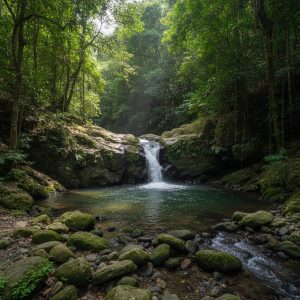
Besides the whales, you can visit the La Sierpe and Tres Marías freshwater waterfalls, go kayaking through the mangrove estuaries, and relax on the beaches of Juanchaco and Ladrilleros.