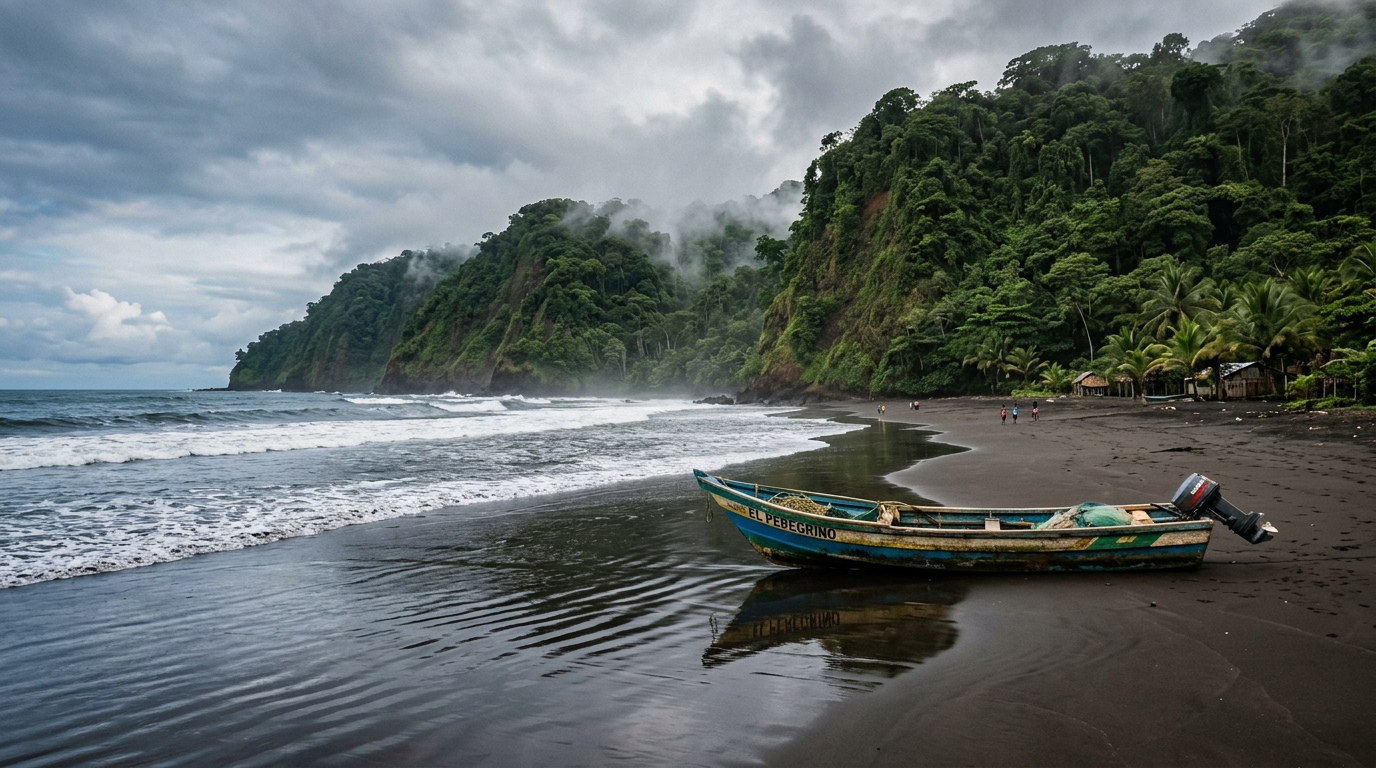
Both appear in DANE’s (Colombia’s national statistics agency) administrative division as populated centers within the Buenaventura district, each with its own codes and coordinates. They are not independent corregimientos or municipalities: they are coastal villages within the same district, which is why almost everyone refers to them together.
| Feature | Juanchaco | Ladrilleros |
|---|---|---|
| DANE code | 76109046 | 76109021 |
| Entity type | Populated center | Populated center |
| Official coordinates | 3.929799 N · −77.356389 W | 3.939476 N · −77.364255 W |
| Practical role | Arrival point: pier and mototaxi stand | Destination point: hotels and beach |
| Park visitor center | Yes | No |
How far apart are Juanchaco and Ladrilleros?
About 1.39 kilometers in a straight line. This is calculated using the official coordinates published by DANE for both populated centers. In practice, the trip is made by mototaxi cart along the road connecting the two villages and takes between ten and fifteen minutes.
How the figure was obtained: The haversine formula (Earth radius 6,371.0088 km) was applied to DANE’s administrative division coordinates: Juanchaco (3.929799 / −77.356389) and Ladrilleros (3.939476 / −77.364255). The result is the straight-line distance between the two points, not the length of the road, which tends to be somewhat longer due to the terrain’s curves.
Using this same measurement method: from Ladrilleros to La Barra is about 2.94 km, and from Juanchaco to La Barra about 4.32 km, always in a straight line.
What’s the difference? Which one is better?
Juanchaco is where the boat docks and where the mototaxi cart stand is, next to the police station. Ladrilleros is where most people sleep, along the beach strip. If your trip is short or your budget is tight, Juanchaco saves you the transfer; if you’re after beach and hotel, choose Ladrilleros.
The difference isn’t about quality but about function, as Parques Nacionales describes when explaining access to the protected area: after getting off the boat at the Juanchaco pier, visitors either walk to their hotel in Juanchaco or take a mototaxi cart at the stand to reach their lodging in Ladrilleros or the entrance to La Barra beach.
Juanchaco also has the visitor center where Parques Nacionales holds the mandatory orientation talk before heading out on marine tours.
How to get to Juanchaco and Ladrilleros
You can only get there by sea. First you need to reach Buenaventura (about two and a half hours by bus from Cali, with hourly departures), then take a boat from the tourist pier to Juanchaco, a trip of roughly one hour. From Juanchaco to Ladrilleros, you continue by mototaxi cart.
The two routes recommended by Parques Nacionales:
- Route 1 (overland): Fly into Cali (Alfonso Bonilla Aragón Airport), transfer to the bus terminal (20 minutes), bus or shared van to Buenaventura (2 hours 30 minutes, hourly departures), and taxi or walk to the tourist pier.
- Route 2 (direct by air): Fly to Buenaventura with Satena from Cali or Bogotá, and take a taxi to the tourist pier (20 minutes).
At the Buenaventura tourist pier (crossing the Paso del Tigre): Environmental authorities recommend buying your boat ticket to Juanchaco at unit 2 (Destino Pacífico office), with typical departure times at 10:30 a.m., 1:00 p.m., and 4:00 p.m., and a crossing time of about one hour.
At the Juanchaco pier: Walk to your hotel if it’s in Juanchaco, or take a mototaxi cart at the stand next to the police station to reach Ladrilleros or La Barra.
Reference transport fares
| Leg | Reference price | Estimated duration |
|---|---|---|
| Buenaventura to Juanchaco (boat) | ~$70,000 COP per person, one way | 45 min to 1 hour |
| Juanchaco to Ladrilleros (mototaxi cart) | ~$5,000 COP per person | 10 to 15 min |
| Total Buenaventura to Ladrilleros | ~$75,000 COP one way | ~1 hour |
The round-trip cost from Buenaventura is around $150,000 COP per person in transport. The mototaxi cart leg is paid directly to the driver in cash on arrival.
Note: Prices verified on-site by the Turismo Valle del Cauca team on September 19, 2026, at the Buenaventura tourist pier. These are not fixed government rates and may vary by season and operator.
Key travel tips:
- The last boat of the day leaves at 4:00 p.m., both from Buenaventura to Juanchaco and on the way back. The regulated entry and exit schedule for the protected area is 8:00 a.m. to 4:00 p.m.
- There is no road access from downtown Buenaventura. The connection is entirely by sea to the Juanchaco pier, complemented by unpaved internal roads between the villages.
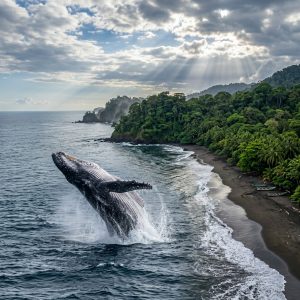
During whale season, the crossing pairs well with marine wildlife watching: check our guide to whale watching in Buenaventura for navigation rules and seasonal permits.
Where to stay: verified, active RNT options
Ladrilleros has the largest supply of beachfront hotels, while Juanchaco mainly offers hostels near the arrival pier. At Turismo Valle del Cauca, we prioritize tourism formality: we list establishments verified in the National Tourism Registry (RNT 2026) with active official channels.
| Establishment | RNT | Lodging type | Capacity (Rooms / Beds) | Location |
|---|---|---|---|---|
| Hotel Pacific Blue Ladrilleros | 92545 | Hotel | 6 rooms / 24 beds | Ladrilleros |
| Bahía del Sol | 52595 | Hotel | 60 rooms / 168 beds | Ladrilleros |
| Pacífico Hostel | 207358 | Hostel | 11 rooms / 36 beds | Juanchaco |
| Hostal Acuarios | 235138 | Tourist accommodation | 12 rooms / 40 beds | Juanchaco |
| Nativo Home | 212294 | Hostel | 10 rooms / 30 beds | Ladrilleros to La Barra area |
| Kambelleh | 250113 | Tourist farm | 12 rooms / 24 beds | Buenaventura (Pacific coast) |
Other formal providers with active RNT registration in the area include Hotel Ladrilleros (RNT 81835), Eco Hospedaje ATA Ladrilleros (RNT 241044), Hotel Malibú Juanchaco (RNT 200616), Juanchaco VIP (RNT 247868), and Fundación Cultura Ancestral de Juanchaco (RNT 99529).
To explore other lodging alternatives in the department, check our Valle del Cauca hotels directory.
When to go: weather, rain, and whale season
The Valle del Cauca Pacific coast is warm and very humid year-round, with rainfall exceeding 7,000 mm annually and average temperatures ranging between 25 and 28°C.
| Weather and biological aspect | Official record |
|---|---|
| Average temperature | 25 to 28°C year-round |
| Annual rainfall | Over 7,000 mm per year |
| Relative humidity | Above 85% |
| Driest months | February and March |
| Rainiest months | September to November |
| Whale tourist season | July to October |
| Biological presence of cetaceans | June to November |
| Peak whale concentration | September and October |
It’s worth noting that the months with the most humpback whale activity coincide with the period of heaviest rainfall, so it’s essential to pack waterproof clothing and proper protection for cameras and phones.
Official safety rules and recommendations
Tourism operations in the area are regulated by the General Maritime Directorate (Dimar) through the Buenaventura Harbor Master’s Office and by Colombia’s National Natural Parks agency:
Maritime safety rules (Dimar):
- Only hire transport services from legally established boats and companies.
- Board and disembark only at authorized piers.
- Wear a buckled life jacket throughout the entire sea crossing.
- Always respect the maximum passenger capacity posted on the boat’s plate.
- Emergency contact channels: Coast Guard line 146, marine VHF channel 16, or National Police line 112.
Uramba Bahía Málaga National Natural Park rules:
- Attend the mandatory 10-minute orientation talk at the Juanchaco visitor center before boarding marine tours.
- Make sure the boat has an authorization flag or marker and a certified guide or environmental interpreter on board.
- Regulated schedule for nautical activities: 8:00 a.m. to 4:00 p.m.
- Whale-watching time limit: 15 to 30 minutes per group, keeping a minimum distance of 200 meters and never blocking the path of mothers with calves.
- Be up to date on yellow fever and tetanus vaccinations, and get medical assistance insurance.
To learn more about attractions in the Pacific capital, visit our pillar guide to tourism in Buenaventura.
Frequently asked questions about Juanchaco and Ladrilleros
What are Juanchaco and Ladrilleros?
They are two neighboring settlements in the Buenaventura district, on the Valle del Cauca Pacific coast, formally registered in DANE’s administrative division. They function as a single tourist destination: the boat arrives at the Juanchaco pier, and most beachfront lodging is located in Ladrilleros, just over a kilometer away.
How far is it from Juanchaco to Ladrilleros?
It’s about 1.39 kilometers in a straight line, calculated from DANE’s official coordinates using the haversine formula. Overland, the trip is made by mototaxi cart from the stand next to the police station in Juanchaco and takes between 10 and 15 minutes.
How much is the boat from Buenaventura to Juanchaco?
The boat fare is around $70,000 COP per person, one way, from the Buenaventura tourist pier, with a crossing time of approximately 45 to 60 minutes depending on tide conditions.
How much does it cost to go to Juanchaco and Ladrilleros?
The base round-trip transport cost from Buenaventura is approximately $150,000 COP per person ($70,000 for the boat, one way, plus $5,000 for the mototaxi cart between Juanchaco and Ladrilleros, one way). Food, lodging, and ecotourism activities are paid separately.
Where is it better to stay, Juanchaco or Ladrilleros?
It depends on your trip plan: Juanchaco is practical for short stays since it avoids the mototaxi cart transfer, and it’s home to the Parques Nacionales orientation center. Ladrilleros offers a wider variety of cabins and hotels with direct beach access and views of the cliffs.
When is whale watching season?
The official tourist season runs from July to October, with the highest number of sightings during September and October in the waters of the Uramba Bahía Málaga National Natural Park.