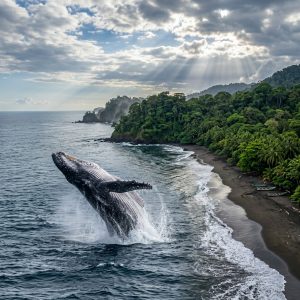
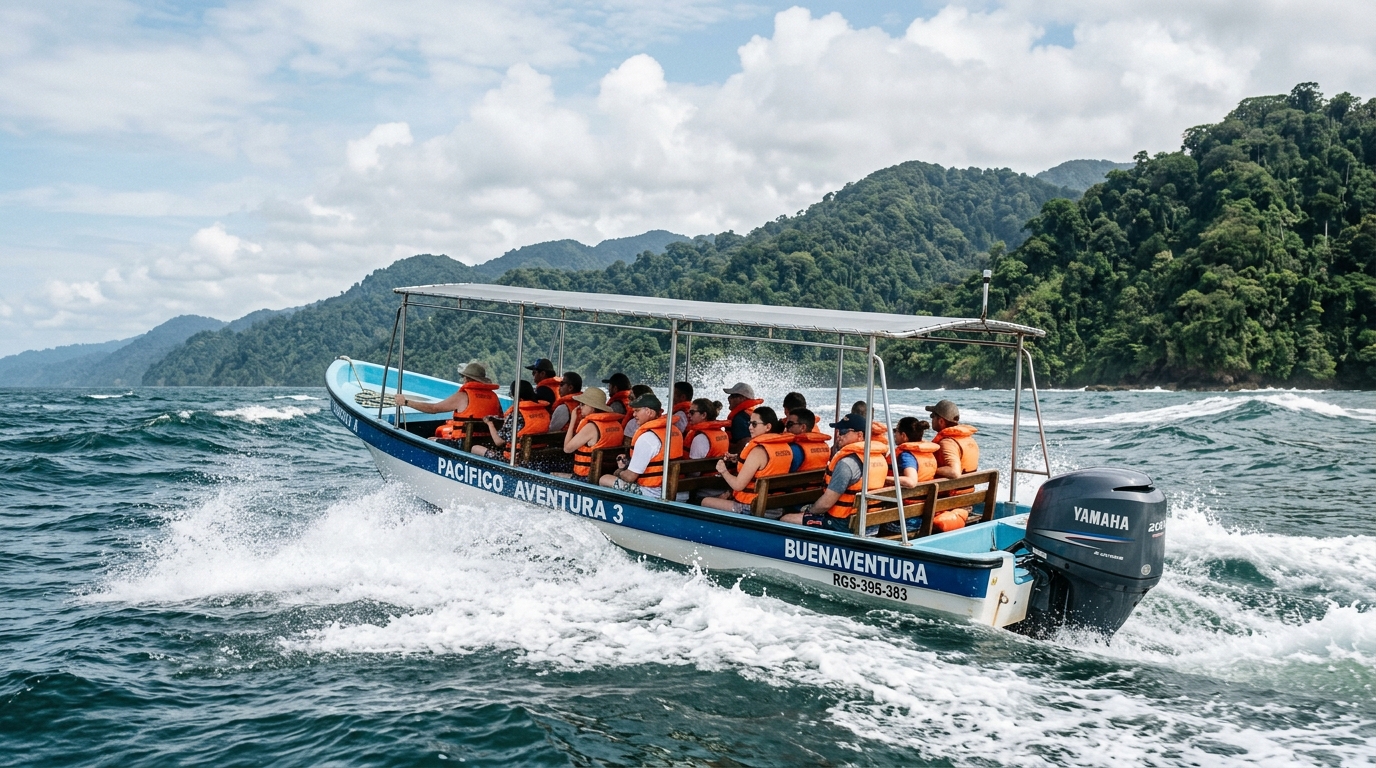
Also known locally and in the national press as Salto del Tigre, every boat traveling from the tourist pier to Juanchaco, Ladrilleros, La Barra, or the Bahía Málaga inlet must cross this stretch both ways. For local boat drivers it’s a routine daily crossing, but for first-time travelers it’s usually the roughest and most memorable moment of the trip.
Where exactly is the Paso del Tigre?
It lies in Pacific Ocean waters under the jurisdiction of the Buenaventura district, along the natural navigation channel that connects the inner bay with the beaches north of the district and the Uramba Bahía Málaga National Natural Park. The only official geographic reference comes from the National Navy, which places it about 20 minutes by fast boat from the district’s tourist pier.
| Key fact | Reference information |
|---|---|
| Geographic location | Pacific Ocean, Buenaventura Special District |
| Sea route | Buenaventura Tourist Pier ↔ Juanchaco / Ladrilleros / Bahía Málaga |
| Point on the route | ~20 minutes by fast boat from the port (National Navy) |
| Common names | Paso del Tigre, Salto del Tigre |
| Access | By sea only, on a passenger boat |
Why does the sea get rough at this point?
The dynamic behavior of the water at the Paso del Tigre comes from the combination of three oceanographic factors typical of the Valle del Cauca Pacific coast:
- Change in sea depth: The seabed shifts in bathymetry relative to the sheltered bay, causing the water to rise as it moves in from the open sea.
- Wind and coastal shape: Sea winds hit the coastline and the mouth of the inlet head-on, generating continuous choppy waves.
- Meeting currents: It’s a meeting point between the tidal currents moving in and out of the bay and the dominant Pacific swell.
The direct result is a constant pitching and bouncing at the bow of the boat. Anyone prone to seasickness or motion sickness should prepare in advance by sitting strategically in the center or back rows of the boat.
Where the name comes from
The name of this crossing comes from the rich oral tradition of the Black and coastal communities along the shore. According to ancestral stories passed down from generation to generation by local fishermen, in bygone times a local hunter took down a jaguar (popularly called “tigre,” or tiger, in the jungles of the biogeographic Chocó) on the coastal cliffs overlooking this strait. Although there’s no documented record of the story, the place name stuck for good in the popular map of coastal navigation.
Is it dangerous to cross the Paso del Tigre?
It’s a crossing that, by nature, commands respect and feels uncomfortable for anyone not used to riding in open boats, but it is not a death trap if you travel under official maritime safety rules. Dozens of authorized boats cross the sector every day, 365 days a year, carrying tourists and local residents without incident.
The documented 2022 incident: On June 24, 2022, a passenger boat capsized in this sector due to sudden adverse sea conditions. Thanks to the transport company’s immediate report and the quick response of the National Navy’s Buenaventura Coast Guard Station, all 24 people on board (19 tourists, 3 Juanchaco residents, and 2 crew members) were rescued alive, with no fatalities or serious injuries. This incident — widely covered on social media and in the press — cemented the crossing’s reputation, but it also proved the effectiveness of rescue protocols when passengers wear their life jackets properly.
Colombian maritime authorities do not issue bans or permanent closures for the Paso del Tigre; instead, they strictly regulate departure conditions and safety equipment compliance for the entire bay and district coastline.
Official safety recommendations from Dimar and the Harbor Master
Colombia’s General Maritime Directorate (Dimar), through the Buenaventura Harbor Master’s Office and under the national “Colombia Navega Segura” (Colombia Sails Safely) campaign, requires strict compliance with the following guidelines:
- Mandatory life jacket use: The life jacket is not carried folded on the floor or under the seat; it must remain buckled and fitted for 100% of the crossing.
- Departure only from the floating Tourist Pier: This is the only formally authorized dock in Buenaventura, monitored by Dimar inspectors and Tourist Police.
- Only hire properly established companies: Verify they have registered vessels, motors in good standing, and pilots with a valid boat captain’s license.
- Respect the maximum passenger capacity: Never board a boat that is overcrowded or carrying excess cargo mixed with passengers.
- Follow crew instructions: Avoid standing up or changing seats while underway, and refrain from excessive alcohol consumption.
Emergency lines at sea: In case of any incident during the crossing, authorities provide the free national line 146 (National Navy Coast Guard), Marine VHF Channel 16 for nautical assistance, and the National Police line 112.
How to check if a transport company is authorized
Technical clearance and maritime navigation registration are granted by Dimar through the Harbor Master’s Office, while tourism business formality is verified in the National Tourism Registry (RNT), overseen by the Ministry of Commerce and the Transportation Superintendency.
Among the providers operating regular departures from the Buenaventura Tourist Pier with valid, up-to-date registrations are companies like Transjuanchaco (RNT 281771), Transportes Asturias (RNT 207357), Destino Pacífico Express (Tourist Pier, Unit 2), and Hotel y Transportes La Fragata (RNT 84611). When buying your ticket at the pier’s ticket windows, ask for a formal ticket with a seat number and travel insurance policy.
Boat schedules and departure frequency
There is no single, consolidated departure time: each boat company manages its own schedule based on demand and tide conditions. The most common departure windows are:
| Route | Typical departure times | Frequency |
|---|---|---|
| Buenaventura → Juanchaco | 10:00 a.m. · 10:30 a.m. · 1:00 p.m. · 4:00 p.m. (last departure) | Departures every 2 to 3 hours depending on occupancy |
| Juanchaco → Buenaventura | 8:00 a.m. · 1:00 p.m. · 4:00 p.m. | Coordinated with hotel check-out times |
Practical tip: Arrive at the Tourist Pier at least 45 minutes early to pay port fees, buy your ticket, and clear the departure check.
How much the trip costs: 2026 reference rates
Reference prices verified at the ticket window at the Buenaventura pier:
- Boat Buenaventura ↔ Juanchaco: ~$70,000 COP per person, one way (~$140,000 COP round trip). Trip length: 45 to 60 minutes depending on the swell.
- Tourist Pier usage fee: ~$10,000 COP per person (paid once before entering the floating docks).
- Motorcycle cart Juanchaco ↔ Ladrilleros: ~$5,000 COP per person (10 to 15-minute overland trip in a covered mototaxi).
- Total round-trip transport cost Buenaventura ↔ Ladrilleros: Around $150,000 to $160,000 COP per person.
Ground transport payments in Juanchaco and small purchases on the beach are made in cash, since there are no ATMs in the coastal villages.
Key tips for crossing the Paso del Tigre without surprises
- Where to sit on the boat: If you get seasick easily, avoid the bow (the front tip of the boat), since it’s the area that rises and slams against the wave crests the most. Ask the deckhand to seat you in the back rows or near the boat’s center of gravity.
- Waterproof protection for your belongings: The crossing produces sea spray and unavoidable splashing. Keep documents, phones, and cameras inside waterproof dry bags.
- Check the marine forecast: Check the weather bulletin from the Pacific Oceanographic and Hydrographic Research Center (CCCP, part of Dimar) to know the day’s wind and wave-height conditions.
- Watch out for spring tides: During full moon and new moon phases, the largest tidal ranges occur (exceeding 4 meters in height in Buenaventura), which increases the strength of coastal currents.
Don’t confuse: Paso del Tigre, Corregimiento El Tigre, and Balneario El Tigre
Online and in tourist inquiries, three completely different places that share the word “Tigre” often get mixed up:
| Name | Type of place | Location | Tourist clarification |
|---|---|---|---|
| Paso del Tigre (or Salto del Tigre) | Open-water sea stretch | Open waters off Buenaventura, toward Juanchaco | The crossing described in this guide; a required stretch on the way to Ladrilleros. |
| Corregimiento El Tigre | Inland river community | Interior river basin of the Buenaventura municipality | An inland village on the riverbank, unrelated to the transport route to the coastal beaches. |
| Balneario El Tigre | Freshwater swimming spot | Piedecuesta, Santander | An attraction in eastern Colombia (widely searched on Google), completely unrelated to the Valle del Cauca department. |
Frequently asked questions about the Paso del Tigre
How much does the boat ride from Buenaventura to Ladrilleros cost?
The trip costs approximately $75,000 COP per person, one way: $70,000 for the fast boat from the Buenaventura pier to the Juanchaco pier, and $5,000 for the overland motorcycle cart connecting Juanchaco to the Ladrilleros hotels in about 15 minutes.
Where is the Salto del Tigre located?
Salto del Tigre is the alternate name for the Paso del Tigre. It’s located in open Pacific Ocean waters off Buenaventura, on the sea route heading toward Juanchaco, Ladrilleros, La Barra, and Bahía Málaga, about twenty minutes from the city’s tourist pier.
Why do the boats bounce so much at the Paso del Tigre?
The pronounced swell is caused by the sudden decrease in seabed depth as boats leave the inner bay, combined with the clash of ocean currents and winds hitting the coastal inlet.
Is a life jacket mandatory during the crossing?
Yes, it’s 100% mandatory under strict regulation by the Buenaventura Harbor Master’s Office and Dimar. The life jacket must stay on and buckled from boarding until you step off at the destination pier.
What time do boats leave from Buenaventura?
Regular departures from the tourist pier are scheduled between 10:00 a.m. and 4:00 p.m., with midday departures added depending on passenger demand and tide. It’s recommended to arrive at the pier’s ticket windows early.
For a general overview of beaches, ecosystems, and destinations along the coast, check out our pillar guide to Buenaventura, the details for visiting Juanchaco and Ladrilleros, or the specialized guide to humpback whale watching.